Most small brands already have what a good ad needs: the product, and a photo of it. What they’re missing is the step in between, the idea that turns “here is our pastry” into something a person stops scrolling for.
This is how that step works: what makes a product ad land, whether you need a shoot, the sizes each platform wants, what to write, and how to find out which version actually sells.
What makes a product ad work?
A product ad has about a second to work. Most people see it small, mid-scroll, with their thumb already moving. The ones that land tend to share four things.
One idea. Not three benefits and a discount. One feeling, said once. “Flaky.” is an idea. “Freshly baked, all-butter, now 20% off, order today” is a list.
The product as the hero. Big, well lit and instantly recognisable. If someone can’t tell what’s being sold at a glance, the ad has failed before they read a word.
One line. Short enough to read at thumb size. If it needs a second line to make sense, it’s probably two ideas.
Built for the feed it’s in. A poster shrunk onto a phone rarely works. The type has to be big, the contrast high, and the important part away from where the app puts its own buttons.
Do you need a photoshoot?
Not to start. A sharp, well-lit photo of the product on a plain background is often enough. A designer can build the scene, the colour and the type around it, and keep the product exactly as it is.
A shoot earns its cost when the ad needs the product in use (someone wearing it, pouring it, unboxing it), when texture is the whole point, or when you need it from several angles. For a first set of ads, one good photo usually goes a long way.
Can one photo really make several ads?
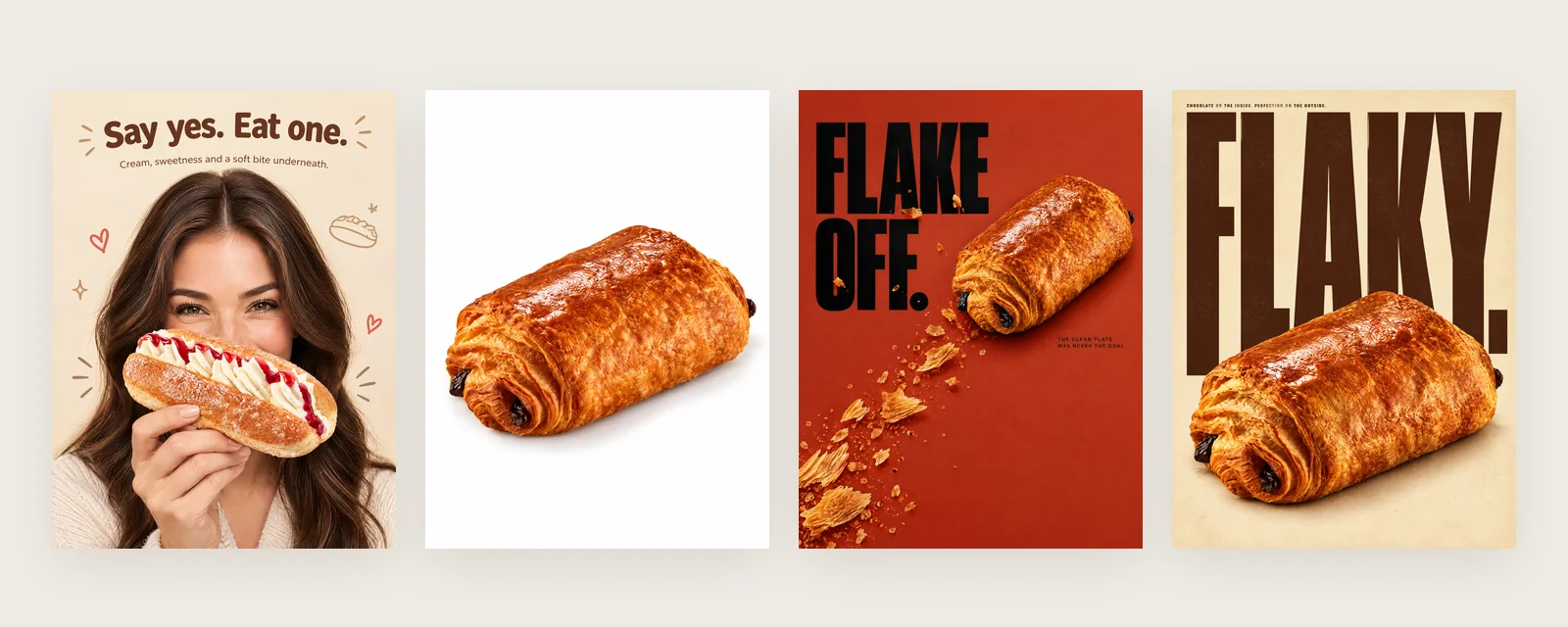
Yes, and it’s the cheapest way to learn what works. We made two concept ads from the same photo of a pain au chocolat (they’re on the cover of this post): “Flake off.” in heavy type on loud red, crumbs flying, and “Flaky.” as one towering word on paper like a bakery bag.
Same product, same photo, two very different feelings. One is loud and funny, the other warm and crafted. You don’t have to guess which your buyers prefer. You can run both and see.
What sizes does each platform want?
Each platform shows ads in its own shapes, and a file made for one looks wrong on another. These are the sizes to make:
- Instagram and Facebook feed
- 4:5 portrait (1080 x 1350 pixels), or a 1:1 square (1080 x 1080).
- Stories and Reels
- 9:16 full-screen (1080 x 1920).
- TikTok and YouTube Shorts
- 9:16 full-screen (1080 x 1920).
- 2:3 portrait (1000 x 1500).
- Google (Performance Max and display)
- 1.91:1 landscape (1200 x 628), 1:1 square (1200 x 1200) and 4:5 portrait (960 x 1200).
Design the idea once, then build each size around it rather than stretching one file to fit. On full-screen sizes, keep the words and the product away from the very top and bottom of the frame, where the app lays its own name, captions and buttons over your ad.
What should the ad say?
Less than you think. The line’s job is to make someone feel one thing about the product, fast.
Say it the way your buyers would. “Worth fighting for.” works for a burger because it’s what you’d say to a friend, not what a menu says. Read your reviews and messages: the best lines are often already there in your customers’ words.
Keep every claim one you can back up. In the UK, the advertising rules (the CAP Code) say an ad must not mislead, and that you need evidence for any claim a reasonable person would take as fact. “The best croissant in Essex” needs proof. “Flaky.” doesn’t.
How are product ads made?
We make ours in Photoshop. The product is cut out of its photo, and the ad is built around it: the background, the light and shadow that sit it in the scene, and the type. The product itself isn’t redrawn, so it stays exactly as it is.
That last part matters more than any tool. The product in the ad has to be the product people get. The UK’s advertising regulator has ruled against social media ads that used filters to make a beauty product look more effective than it is, and the same thinking applies to any retouching that changes what you’re selling.
Change the scene, the light and the words as much as you like. Keep the product true.
How do you know which ad works?
You test it. Make a few genuinely different directions, run them side by side with a small budget each, and judge them on the thing you actually want: clicks to the shop, sales or enquiries, not likes.
Give each one long enough to show a pattern before you decide. When a winner starts to tire (the same people have seen it too often and results drop), make a fresh version of the idea that won rather than starting from nothing.
When is it worth getting help?
You can do all of this yourself with time and a good design tool. It’s worth handing over when you need a steady supply of new ads every month, when you need every idea in every size, or when you’d rather spend the time on the business.
That’s one of our services: send us a clear photo of the product, and we design the ads in Photoshop and hand them over in every size, ready to run. A single ad is £59 and a pack of five is £229, every size included, and a monthly plan keeps fresh ones coming. Every price is on the pricing page.